
Sonic Joy: Thief of Trance Beats

Long time no post. I had been busy with work and just wasn't able to make time for music.
But I am back with a new song.
As usual, please give it a listen while you read:
AN OVERVIEW:
This song is for a different project unrelated to the game soundtrack.
This song all came about because I simply heard some bopping sci-fi robot music in the background of some video I had on play while I did the dishes. I wanted to write some music like that, so I set out with a goal:
Sound sci-fi and spacey
Tense, "combat ready" vibe
Relentless energy.
Lots of phasers and filter sweeps
maximum JP-8080 usage
STRUCTURE:
The song shares a lot of DNA with This Ain't Even Home, my previous release; and to a lesser extent, the Tuesday song, with it's progressive evolution and build up.
It's got that Mario level structure to it: bring in an idea, explore that idea, evolve that idea, forget that idea and bring in a new one. Rinse, repeat, then combine both ideas.
I'm still deciding whether I like this song structure or not, but whether it's good or bad, I do think it's interesting!
THE SOUNDS:
Only JP-8080 love here (and a tiny little bit of Kontakt and me doodling on the guitar)

In total, there are 6 patches from the JP-8080, plus drums from Zenology, choir and string Kontakt libraries, and finally me plucking away on my PAC-311 Guitar.
THE JUPITER PATCHES
Strap in, you're coming along for a ride here as I go over each of these patches because I think there is something interesting about each on.
Starting with...
303 - Nothing says "90's/00's techno/trance" more than a squelchy 303 bass.
This patch is mostly the built in 303 emulation preset that comes with the JP-8080 with some minor adjustments.
The mixing on it is also mostly unremarkable other than side-chaining a low shelf EQ band to the kick to tame the song's bass.
Sweepsaw Pad - The Sweepsaw pad I made is actually comprised of 2 JP-8080 patches.
It's comprised of a pretty basic sawtooth patch with a slow LFO sweeping the filter, then a second patch with sawtooth arpeggios.
The mix utilizes a phaser as well. In this case, it was Arturia's Bitron.
Mecha Punch, the Digital Stab - The first lead sound to enter the song. It has a rich and crunchy bottom that is less heard in the song. It's a full frequency stab with aggressive digital vibes.
When it is first brought into the song, it plays it's melody straight without being modified, but later I open up the filter and sustain to give it the fuller sound. Around the 2 minute mark though, something happens to it...

This is where MPhaser comes in. I start heavily modulating the sound into this digital warbling that swings between ringing and crunch. This was done through MPhaser. Over the span of that entire section, I am increasing the "mode" as well as the maximum response value.
I also use this same modulation as a fill between phrases, quickly modulating the mode steps to create a digital warble.
This effect was a complete accident when I stumbled into it. I was trying to find the perfect mode for it to oscillator through, unhappy with any one particular mode I quickly swept the mode knob and heard that digital warble and loved the effect.
BigSaw, the gnarly super saw - The BigSaw patch comes in at the same time the sustain is raised on the Mecha Punch patch, but it becomes much clearer just after the digital warble phasing of the Mecha Punch. This huge sound was created using the Super Saw oscillator from the JP-8080, but it alone doesn't sound so demonic. To pull Satan out of the circuits of the JP-8080 it was necessary to add Arturia's Coldfire and Jun-8 Chorus, as well as double track it with a favorite simple little plugin called Twin Pitch.

What you might not realize however, is that the BigSaw remains present for the rest of the song once it gets introduced.
After the verse, around 3 minutes I enable a phaser on the BigSaw which creates the bubbly resonant rhythm. That little resonant bubbly sound is the same BigSaw. (I like to think it's Satan protesting going back into the circuits.)
This bubbly sound was creating using MPhaser with high feedback and a complex oscillation pattern.
Pluckasaurus - Around 2:30 when the verse comes in the Pluckasaurus was introduced (as well as the PAC-311, but more on that later).
The Pluckasaurus is a very high-treble pluck. It mostly acts as a texture for the rest of the song. It's easiest to hear during the outro of the song. While the pluckasaurus itself doesn't have any particularly interesting techniques unique to it, it is one of many sounds in this song that utilized what I will call "Delay Drift".
Take a look at this gif:

Many delay plugins use time shifting when the delay rate is modified. The result is that the pitch shifts if you move the delay knobs. I used this pitch shifting effect quite heavily in my song Faith from my old album, Believe. However, what makes my usage of that behavior different here was using the effect in a more subtle way.
By setting an LFO to modulate the time of the left and right delay by only a tiny amount, it creates this subtle, but warm analogue sounding pitch drift - thus, Delay Drift. Many of the "bed" instruments (like the Sweepsaw) utilize Delay Drift in this song.
THE OTHER INSTRUMENTS
Obviously the JP-8080 takes the spotlight in this song, however there are some other instruments that come in later.
PAC'ed - Around 2:30 (when I summon Satan from the circuits of the JP-8080) I start plucking away on my PAC-311 with stainless steel, flat-wound strings.
Since I am awful at playing guitar, the guitar part is actually really simple. I am just arpeggiating a single chord, going up the notes.
It mostly acts as a texture bed for the song (so you know that means it features Delay Drift), but it also has an LFO modulating a high pass filter that is 180 degrees out of phase with the Sweepsaw (meaning the guitar is bright when the saw is dim).
Despite how simple the guitar part is, it adds a warm analogue texture to the ever growing dense body of the song.
BOW'ed - Featuring strings in my music is nothing new, however there is some behind the scenes stuff that may or may not be interesting.
I wanted the strings to feel as if I sampled another song and used the string in my song, but I didn't quite achieve that affect. They still sound like strings from a Kontakt library.
I did run them through a tape filter and process them to sound a bit crispy, but the fact of the matter is that I didn't achieve the effect I wanted here.
Ooo'ed
I heard this interesting solo vocal sample in a game trailer (I believe it was Marathon 2026) and since then I have been wanting to recreate what I (thought) I heard.
I disabled the legato, release, and round robins of the Kontakt library on my solo choir vocal library to achieve a 1-shot-sample kind of feel to the vocals. From there, I used a lot of FX to brighten and bring the sample so far forward you can hear every breath.
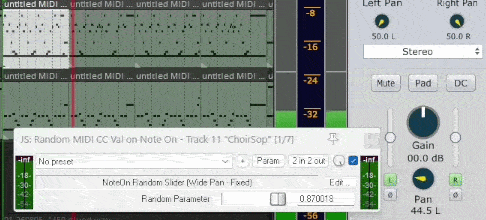
One special technique I used was randomly panning every time a note was triggered.
There isn't an easy way to accomplish this out of the box in Reaper. After some searching of the Reaper forums, I found someone had made a pretty simple JSFX for Reaper. It's a simple knob that picks a random position when a Note On signal is received. This can then be mapped to modulate another FX knob, in this case Venn Audio's Pan knob.
I made a slight modification to the JS to have the knob only select positions within the first and last 25% of the pan (so basically it avoids the middle 50%)
CONCLUSION
I really enjoyed making this song, and overall I am very happy with how it turned out. Unlike This Ain't Even Home, I am mostly satisfied with it.
To reflect on some of the choices, there are 2 things I wish to improve.
Firstly, the loops that make up the song are very simple - usually no more than 4 bars - and there is really only 1 chord. This comes down to how the song was written, which is my use of hardware synths and how I build out my songs.
I usually build in small chunks: build out the chorus, build out a verse, build out an intro, build out the second verse/chorus, build out the outro.
The problem comes in with hardware synths. I can't run 200 instances of the same synth. So when I want to hear the "full symphony" as I build out the song, I need to record the current synth performance so I can build a new performance with a different patch on the same synth. I need to find a workflow that works with my process while allowing me to easily modify multiple synth patches with few recordings before the full song is composed. That's tough to figure out!
Second, is the "Mario Level" song structure. Like I said earlier in the post, I have mixed feelings on this. There are some ideas that I wish could have come back later in the song, or were evolved on more. But the way the song is structured is that lead instruments get forgotten and moved on.
I think the song would have gone a completely different direction without this song structure (likely the choir and string ending wouldn't exist in this alternate timeline). The song likely would have been far more traditional trance-y techno.
Neither of these things are bad nor good. Just a different reality. Which is why I am mixed on it. But, I think it's time for me to focus on a different type of song structure.
Overall, though, I am very happy with the song.
Next up, I'll go back to soundtrack music, so I'll be leaving the synths behind for a bit. I have a song I started a few months ago, but I got caught up in work that it got pushed to the side. I think it's time to return to it and finish it. Hopefully before the month ends!
sorry, I don't have the plugin list like I usually do this time! I mostly used all the same plugins featured before in previous posts, though!


Comments