top of page

All Posts

It's been a month since I last posted any music, but I have something special today.

As usual, please listen to it while you read:


You might assume that it's just some typical EDM music, and on the surface, it more-or-less is (I do feel it's a style of music that has fallen out of popularity in recent years, so in a sense has become unique)

The truth of the matter is that (other than the vocals) every sound comes from the very basic ReaSynth plugin that comes default with my DAW, Reaper. Yes, that's right, every sound, including the drums!

I'm gonna get pretty technical in this one, so strap in. But first, some context.


TRAPPED IN A BOX:


Recently, I was stuck in a tiny hotel room for a month. All I had brought with me was my laptop which runs Linux. I didn't have any of my typical equipment or software for music making and mixing.

However, I was desperate to create music! Reaper, fortunately, is available for Linux, however, the plugins I use are not.


In a previous blog post, I talked about Geraint's JS plugins for Reaper, and while I had initially planned to utilize those -- he even has some great sounding JS synths -- I decided it would be a fun challenge to only utilize the default tools that come bundled with Reaper 7.60


ReaLIMITS:

Limiting myself to just the ReaPlugs and JS plugins that come bundled with the software was quite the challenge. The first major roadblock I hit was that only 1 instrument comes bundled by default with Reaper!

It is a simple Synthesizer with limited controls:

A basic gain slider, a global tuning slider, ADSR for the amp envelope, a portamento time slider (that also forces the synth into mono mode if set to any value above 0), and finally a mixer for basic oscillator shapes: square + pulse width, Saw, Triangle, Sine. It's worth noting that it is only a basic mixing of the oscillators as there is no feedback function, ring or sync to create complex oscillators, or individual oscillator tuning.

Also of notable absence is a cutoff filter and a filter envelope (obviously there wouldn't be an envelope for the filter if there is no filter in the first place)


ReaNOISEMAKE:

Being limited to the basic oscillator shapes really wasn't too big of a deal - it's easy to make some sort of energetic synth sounds for electronic music. I will admit that a plain oscillator produced digitally is a little bit dry and boring of a sound, but due to being simple makes it a palette to add character to (through effects).

The bigger challenge was going to be the drums.


Anyone who has used a drum machine before likely knows the common ways of synthesizing a kick drum and snare drum. Both more or less follow the same basic concept, just with different tuning and filters.

In essence, to create the "thock" of the drum, you sweep a filter across a tone. The base oscillator doesn't really matter too much, though I think your 808s and 909s use a triangle or sine to get a purer thock tone.

For a kick drum, it's pretty much only the filter sweep and nothing else. Maybe occasionally mixing in some noise just to add a little "plastic" to the kick hit, but the filter sweep is doing the heavy lifting for it's sound.

The snare is almost the inverse, where the noise layer is going to do the heavy lifting for the sound of the snare while the filter sweep is mostly there to add some low-end body.


However, some questions arise:

How do you sweep a filter if the synth doesn't have a filter to begin with?

And what about hihats or other cymbals? How do you make those!?!


ReaROUTE THE ENVELOPE:

Let's start with basic concept that is utilized through out the song: Using the audio output's own envelope to modulate a filter.

Basically I am feeding the audio into a plugin (in this example, an EQ plugin) and using the amplitude of the audio output as a controller to modulate a parameter in the plugin (again, in this example, the frequency band of a low pass filter).

This screenshot shows direct chaining to modulate an EQ band to add character to a synth, but the concept for the drums is the same.

In general, this type of technique is often used in what is called "Side chaining", which is to link an external audio output to a side channel of another input. In typical side chaining, as the name implies, the audio is coming from the side and is therefore not heard by the listener, but that channel can "hear" it, and therefore using the input audio to modulate a parameter - most often this might be tying the kick to the side channel of a synth's gain or compressor to make the synth duck or "pump" when the kick hits - something that was also used in excess throughout this song.


However, in the case of creating the drums for this song, rather than side chaining the audio, I "direct" chained the audio.


This "direct chaining" technique was used throughout the song in many different subtle ways, but the main and most important one was modulating the snare and kick's low-pass filter to create a frequency sweep.


ReaCYMBALS

So we discussed that snares and kicks are just filter sweeps (for the record, so are toms since they are just shrunk-down kicks) but what about the other half of a good drum kit -- the cymbals?


When it comes to the metallics of a drum kit, things are not as clear cut in how to get from basic oscillator to metallic sound.

With a noise generator, some basic oscillators, and a filter you could create a crude facsimile of tons of sounds, but metal is not one of those!

Metallic sounds are actually quite complex sounds and depending on the size of the sheet of metal - in all dimensions - that sound can change quite a lot. This is important because making a hihat is a little bit different than making something like a ride cymbal. However, just like woods of the kit, there is still a fundamental underlying concept I will employ to get to the end goal: metallic instruments.


Firstly, we need to establish that a good hihat is actually a little bit noisy and bright. While starting off with a noise generator is possible to get to where we are going, in the end I decided to go with a square wave to make the basic sound. The square has a bright sound with many resonant peaks that I think makes a good base for a metallic instrument; a saw would also have been good too, but I felt it was just a bit too chaotic and scratchy.

After some EQing to emphasize the trebles and cut the bass and reduce the mids, I had the "basic character" of a hithat.


From there I used a ring modulator. If I am being honest, I don't fully understand how these weird little tools work -- in fact, I have rarely used one in my own music. From what I understand, it applies another oscillator (likely a sine wave) to add and/or subtract from the incoming oscillator. Basically, the effect is that it creates "ringing" tones by emphasizing some peaks while de-emphasizing others (though, from my reading, that's not where the name is derived from, but rather how the analogue circuitry for a ring modulator is a ring of diodes)


I would say the ring modulator got me half way to where I wanted to be - the ring modulator brought some of the chaotic harmonics into the mix that the pure tone of the base oscillator didn't have, adding in that metallic noise, but it didn't quite achieve the brightness a cymbal is distinctly known for.


This took some searching through the various JS plugins that come packaged with Reaper where I found an interesting little tool called "Paranoia Mangler".

The tool itself does quite a few things, but at it's core it is a bit crusher/sample reducer (with some built in filters).

The sample reduction is the exact thing I needed to bring in and emphasize the added metallic noise from the ring modulator. By reducing the sample rate, artifacting happens, which is particularly emphasized in the trebles.

With some careful playing around with the sliders, I eventually got something convincingly hihat.


ReaCHARACTER

With the drums established, it was time to turn my attention to the synths.

I won't go into as excruciating details about every synth sound. I just want to highlight a couple of things to help give the flat and boring sound of a single oscillator a little more character.

  • The main bass line throughout the song and the "big synth" sound heard for the chorus both use the direct chaining to sweep a band up and down the frequencies. It's kind of like a single band phaser that follows the envelope.

  • The plucky lead square wave instrument is comprised of 3 tracks. 2 of the tracks have the tuning slider of ReaSynth being modulated by an LFO to create a slightly unstable sound to it's tuning.

  • Many instruments have a very large bump in an EQ band to over-emphasize a specific tone the synth generates.

  • Overall, many synth parts are comprised of multiple tracks, being layered together to help create a bigger sound.


ReaWHUUP

There is a particular synth sound that comes in the middle and the "This Ain't Even Home" lyrics that sounds like it's going "Whuup!"

I just wanted to draw particular attention to this sound as it was quite complicated to create. It also does direct chaining to modulate an open-to-close filter sweep, but in addition to that it also uses the pitch wheel to quickly rise up, then fall back down. That's just for 1 voice. It's actually comprised of 5 voices with various pitches and tunings.

The Whuup sound was a lot of fun to create. I was really happy with how it turned out.


FINAL MIXING

It took me awhile to adapt to using my laptop and a newer version of Reaper for my music writing, so the song took about 2 weeks to write (though there was an extended holiday in the middle that interrupted work on the song).

The biggest challenge was just making it sound properly mixed utilizing just my bluetooth earbuds and the TV speakers. I knew I would never get a mix I was fully happy with, especially because I was very disappointed with Reaper's default reverb plugin(s) and compressors. So I made a "good enough" mix sticking to the challenge of this project: use only the default tools of Reaper. But I made plans to do a proper mix as soon as I returned home.

The final mix using all my expensive tools is here:

Please listen to it while I wrap up.


ReaFLECTION

The core conceit of this project was a lot of fun -- though I don't think I want to try it again any time soon.


There is often a sentiment among musicians - maybe all creatives - that you don't need expensive tools to create. That much is true, no doubt about it. But I would argue that expensive tools make creating much easier. The final mix sounds fuller, clearer, and has more character. This is thanks to being able to hear it properly on my monitor speakers and headphones. Some of the space and depth comes from...well, yes, free plugins, but a handful also are plugins part of expensive software packages.

So, let it be known: You don't need expensive tools to make good art...but they certainly make the job easier!


As for the song itself, there is a lot I like about it, and a few things I don't like about it.

The song structure itself is really interesting to me. It sort of follows an ABAB song structure common to pop music (in that the base rhythm and melody doesn't change much), but really it's more like ABCDEBB; where, besides the chorus, each part is new, building off the last. Neat!


The use of vocoder was a fun experiment. I've wanted to incorporate a vocoder into my music for awhile now, but didn't have the courage to sing. (Fun fact, I planned on writing and singing lyrics for this song originally, but found my laptop mic did not suffice and MychMych's performance was too good to pass up) I didn't have much opportunity to talk about the vocals in this post, but it's worth mentioning that the tone of the vocoder still comes from ReaSynth. It's ReaVocoder that processes the synth's inputs to modulate the vocal track.


The repetitive "This ain't even uh...This ain't even our home" section (which, by the way, I'm not actually sure those are the actual lyrics, but I can't unhear it that way) coupled with the Whuups is absolute fire and makes me want to cut rug every time I hear it. By far, this is the biggest hook of the song.


The things I am not entirely happy with is the intro.

The intro doesn't really capture my imagination. In fact, I sort of feel the opposite. If this song came on the radio and that was the intro, I'd probably tune out quickly. I think this comes down to a few things:

  • Rhyhtmically, it's not very interesting.

  • Sonically, it's okay, but feels like a bass we've all heard before.

  • Melodically, it's stagnant and not very expressive.


You may not notice this, but the notes of the bass actually change. It starts off with a simple pattern, which quickly evolves into a slightly different pattern. I think, ideally, the evolved pattern should have been the starting pattern.

I also think the hihats should have been present in the intro. This is because, sonically, they are very interesting. Your brain says "That's a hihat...but somethings wrong." so it really captures your attention. I however, fell into the trap of following a typical techno progression by having the hats come in later during the build up since they tend to be more exciting.


I also don't like the mix on the "big synth" in the B-parts (chorus).

To be honest, in the mix I did at the hotel, they seem okay. Not great, but serviceable.

In the new mix, I feel like some of my processing on them erased some very necessary excitement in their performance. Couple that with it sharing the same uninteresting rhythm as the bass, and it overall just feels tired; existing, but without much purpose.


Finally, before signing off, I would like include a couple bonuses.

I'm certain there might be a few readers who go, "Huh, I wonder what the song would sound like without all the processing."

Well do I have good news for you!

I've rendered out the song with most* of the processing removed.

First is a very, very dry mix:

(*read note below.)


This mix even removes the processing from the drums, so you can hear what they sound like unprocessed. However, they sort of mask what is happening with the rest of the song. They are pretty integral to the song, so I've done another mix where all the processing EXCEPT for the drums has been disabled:

(Actually, sad news: Wix's blog editor doesn't seem to let me post sounds directly into the editor. I don't want to flood my soundcloud with nonsense "behind the scenes" tracks, so for the time being, those aren't being included. I'll try to see if there is something else I can do.)

*it's worth noting that some reverb, main compressor for side-chaining, and some of the master bus effects were left on it. It's not a truly dry mix, just a mix of most processing disabled.


SPECIAL THANKS TO

MychMych for releasing his acapella for use:


TOOLS:

These are not affiliate links, they are simply giving you quick access to learn more about the tools I used.


DAW:


HARDWARE:

Samsung Galaxy Buds Pro

Whatever TV was installed in the hotel room (I think it was a Sharp)

Yamahas HS8s

Audio Technica AT-m50x


SOFTWARE:

Instruments:

  • ReaSynth

Effects:

  • ReaEQ

  • ReaComp

  • ReaXComp

  • ReaLimit

  • ReaPitch

  • ReaDelay

  • ReaVerbate

  • ReaVerb

  • ReaVocode

  • ReaGate

  • JS: 4 Tap Phaser

  • JS: Moog 4 Pole Filter

  • JS: Saturation

  • JS: Exciter (Treble Enhancer)

  • JS: Digital Drum Compressor

  • JS: Noise Generator

  • JS: Tremolo

  • JS: Delay w/ Tempo Ping Pong

  • JS: Paranoia Mangler

  • JS: Flange Baby

  • JS: Ping-Pong Pan

  • JS: 1175 Compressor

  • JS: Event Horizon Clipper

  • JS: Ring Modulator

  • JS: Transient Controller

  • JS: Amplitude Modulator

(The effects below were used on the final mix)


Please listen to the song while you read 🙇


WRITING WEDNESDAY


Within the span of 10 days, I have completed another song. It is not typical that I have such high output of music, but I have been challenging myself lately to complete more songs, faster. Maybe in a future post I will explain why.


Following on from Tuesday Tidings, Wednesday is attempting to capture what I think the day of the week feels like.

As Wednesday is the middle of the week, it feels the hardest; deep into the work week, the weekend feeling far away. I wanted to capture the feeling of the "trudge through the workweek" in the song.


I knew I wanted the cut time kick-and-rimshot snare with the arpeggio on an electric guitar.

From there, I played around with a variety of sounds to help fill out the arrangement of the song.


HARDWARE:

The bassy/farty synth that comes in around the 50 second mark is actually my Casio CTK-630

Specifically it's using tone 40: synth-bass 1.


My CTK-630 is a "custom" job I did, shrinking the package down by lopping off the attached keyboard and speakers and replacing the back so that it can fit in the small space of my studio more easily. While it's difficult to find the right song that fits the CTK-630, I absolutely adore the cheesy sounds it is loaded with.


And of course, it just can't be a song I wrote without featuring my beloved JP-8080!

The high-resonant lead synth heard around 1:30 likely is no surprise that it came from my JP-8080. The modulating on the filter was performed by me, rather than using automation lanes or MIDI.

You may notice that at times the opening and closing of the filter seems a bit off beat. After some debate, I decided to keep this off-time "drunken" performance in the song -- it seemed fitting!


What might be more of a surprise is that the deep, smooth bass that plays throughout the song is also a patch I built in the JP-8080.


THE MIX

Surprisingly, I had a tough time getting a comfortable mix on this song. It mostly comes down to how I wanted the jazzy "Doodoo"s to sit in the mix - but more on that in a minute.

(Yes, I will continue to call it "doodoo" from here on out because my humor is that juvenile)


THE GUITAR(s)

It might surprise you that there are 3 tracks of guitars here.

At first, I just had one grungy guitar riding the arpeggio, however, it felt a little too aggressive and rock-ish to adequately fit the mood of Fidel. With some experimenting, I eventually landed on adding in the warbled guitar (Very Dead Pirates coded). It felt appropriate to make it wide, so I double tracked it, leaving the grunge guitar center panned and having the warbled guitar wide and to the side.


About the doodoo...

I struggled to get them to fit into the mix. I wanted them to be present and forward, but also I wanted them to be in the background. What a conundrum!

The doodoo has been double tracked, wide and to the side. Naturally, I had to squeeze in the existing "wide and to the side" warbled guitars a bit centered to make space for the doodoo. I also emphasized the doodoo's gain a lot more, relative to the other instruments.

However, gain and panning was not enough to satisfy the doodoo mix.

The struggle commences...


After iterating through various methods of compression, over compression, OTT compression, EQing, filtering, reverbing, I just could not get the doodoo to sit right with me.


2 things finally helped it feel "right".

Firstly, using an ADSR* filter on the doodoo envelope. Specifically, I used Arturia's DRUMS plugin, which as the name implies, is really more meant for drums and not filtering doodoo, but because it has built in ADSR filtering, and it is very efficient at reading the envelope, it seemed like the best tool for the job.

By using DRUMS I was able to adjust the ADSR to emphasize the D in the doodoo, and reduce the oo in doodoo gradually, making it have more punch and cut through the mix - kind of a DooDoo instead of doodoo

But this caused a problem...

(*ADSR stands for Attack, Decay, Sustain, Release. Attack is the initial hit, decay is how quickly the volume lows after the attack, sustain is the volume in which is is lowered to after the attack, and release is the tail that follows after the sustain.)


At 1:30, legato doodoo is brought in, and with DRUMS the doodoo did not legato. So for each instance of legato doodoo you hear throughout the song, it was necessary to use an automation lane to bypass DRUMS effect on the doodoo.


Would you believe me if I told you I still wasn't happy with the doodoo?


Often, when I write music, I make a preliminary mix. This mix is a mix that I expect will likely need altering, but it's mostly a completed song. Once the preliminary mix is rendered out, I often dump the song onto my phone and go for a walk, where I listen to the song through some consumer-oriented earbuds. This gives my ears a rest from my typical monitoring sources (HS8s and M50x) and allows me to sanity check my own mix. And while I was taking my mix for a walk, I felt miffed the whole time! The doodoo stank!


When you have a hammer, everything looks like a nail.

I avoid overtly technical and modern mixing techniques as they often leave the mix feeling lifeless or overly produced. Sometimes it's not just okay to have some clashing frequencies, I'd argue it's the soul of the mix (not the music though - different thing).

That being said...Oeksound's Soothe 2 has a nifty feature of monitoring a side-chained source and dynamically reducing frequencies of the output. What this does, in effect, is - unlike traditional gain-reduction side chaining which would lower the whole tracks volume to make space for an instrument, this instead only lowers the gain of the necessary frequencies for the side-chained instrument to cut through.

Very cool! I hate it.

As with any tool, it has it's place. But it's an overkill solution for what is a fundamental mixing problem. I would rather solve the problem at it's core, rather than smash the problem with a hammer.

Regardless, that was the ultimate solution used here; with the doodoo being side-chained to the piano, vibraphones, and warbled guitar to help it punch through more clearly.


CONCLUSION


This post is getting a bit long, so let's wrap up.

One final interesting tidbit I didn't have space for in this post was the musical quotation of The Gathering's "My Electricity". This was done deliberately. The Gathering has been a favorite band of mine since high school.


The song started out feeling mid, and even as I was deep into writing the song, I only had "okay-ish" feelings on the song, but nothing about it had really excited me. My goal was to just finish songs quickly, so I pushed through.

However, a breakthrough did happen about 2/3rds through the writing. When the warbled guitar takes over the melody in the last portion of the song, I really liked how well the guitar came out. I wish I could have performed it on my own guitar, but sadly my guitar skills are still severely lacking -- I will continue to rely on Kontakt libraries for my guitar for the foreseeable future.

It might also be a surprise that the doodoo was a last minute addition to the song, and I really feel like this was the unique hook that made the song go from feeling "mid" (in my eyes) to elevating it to a good song (I think I still like Tuesday Tidings more, though).


I'm glad I could explore using funny sounds like the doodoo and CTK-630. Perhaps I should try utilizing similar types of sounds in future songs.


TOOLS:

You'll need to forgive me, as I am writing this list off the top of my head and may have missed some tools used.


These are not affiliate links, they are simply giving you quick access to learn more about the tools I used.

DAW:

Reaper 6.30

HARDWARE:

Roland JP-8080

Casio CTK-630

Arturia Keylab 88 mk. I

Donner Noise Killer

SOFTWARE


Please listen to the song while you read 🙇


INITIATION


Nearly every song I have written has some interesting bit of lore to how it was made.

I've always enjoyed talking about how my music came to be, so I thought I might write about it in a blog post!


My most recent song is a soundtrack song for my game, Fidel & The Pauper's Paradox (which you can read more about it here)


ABOUT THIS SONIC EXPERIENCE


Originally, this song was going to be written for Saturday and not Tuesday. So, for my Saturday concept, I had the idea of making the soundscape of something like a busy market street (because Saturday would be the day everyone is out and about, going shopping, to restaurants, events, etc).


TEXTURES


To achieve this concept, I had the idea of building up layers of repetitive instruments to create a texture of noise.

To help create the textures I did a few fun things for the production of the song.

First, of note, are the (non drum kit) percussion elements.

I have no word to describe this other than "The shit in my drawer". It is comprised of a ratchet wrench, the top to a wooden box, and a plank of wood. The wood box and wood plank were struck with a cork mallet that I had constructed myself from a wine cork, wood dowel, and some 5 yen coins to counter-balance it.


to further create the rising texture I wanted an array of random notes.

The problem with true randomness would be nothing short of a chaotic and atonal mess.

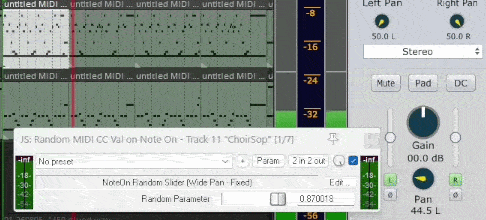
After some searching I found Droplets by Geraint. Mister Geraint has some really wonderful JS plugins for Reaper. Droplets takes a MIDI chord and will play random notes within that chord, with a few parameters to adjust the pattern and frequency. But the result is something truly random, just like I wanted.


Droplets was used on the piano track -- which is mostly buried in the mix, only there to provide the texture -- and there is a metallic percussion sound. This is actually a heavily modified music box sample (the envelope has been adjust to mostly just accent the metallic noise of the first string and remove the ringing afterwards).


As the instruments build up, short melody passages creep though, which was intended to be as if you catch just a brief few words of a nearby party speaking on the busy street. These passages mainly come from the flute and the guitar.


FLUTES


So fun fact about the flute!

1) I have never used a flute in my music before!

2) I don't have a good flute sample library to draw from.


The flute itself was a pretty cheesy sounding soundfont drawn from Zenology. It comes with a wide variety of soundfonts, of which is a legato flute and a "jazz flute" (which is just staccato playing with a breathy layer added to it).

In order to create an acceptable range of articulations for the flute, I combined these 2 soundfonts on separate tracks and side-chained the staccato flute to the legato flute. This, in effect, causes the legato flute to "drop out" when the staccato note plays, and thus blends them together more naturally.


CHANGE THE DATE: SATURDAY TO TUESDAY


So why did it become a Tuesday song instead of a Saturday song?

As the song developed, I found that relying primarily on more pure-toned instruments (bells, flutes -- you know, instruments without a lot of harmonics) helped reduce the chaos in the mix. The result is that, these pure tone instruments tend to be reified in usage; bells tend to be wintery, flutes tend to be springy. The overall vibe of the song shifted from "busy market street" to "winter giving into spring" (appropriate given the time of year I wrote this song).


Without going into obsessive detail, the daily songs in the game assume a typical schedule for a person's play time (busy weekdays, free weekends). So I am very particular about the Saturday and Sunday songs, but weekday songs I'm more lenient with. I feel like that the song does not have the right "steady energy" for Saturday and may become tiring to listen to for really long play sessions.


CONCLUSION:

This song quickly became one of my favorite songs. There are lot happening -- both intentionally and unintentionally thanks to the texture of notes. It makes every listen to the song interesting as you pick out something new you didn't hear before.


My only criticism of this work is that the build up comes and goes too quickly. I think the song would have improved if there was one last passage that included a melody and the choir before ending.


Regardless, I am very happy with the song and I hope you enjoy it too!

Following, I will share the tools I used for this song in case you are curious.


TOOLS:

You'll need to forgive me, as I am writing this list off the top of my head and may have missed some tools used.


These are not affiliate links, they are simply giving you quick access to learn more about the tools I used.

DAW:

Reaper 6.30

HARDWARE:

Roland JP-8080

Arturia Keylab 88 mk. I

Donner Noise Killer

The random shit in my drawer

SOFTWARE


Fidel & The Pauper's Paradox and the FatPP logo © 2025 Nolan Alighieri
Powered and secured by Wix

bottom of page